China Top Ethernet Cable Labels Manufacturers
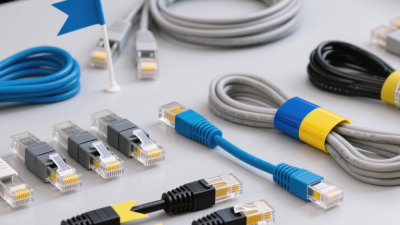
In modern server rooms, Ethernet Cable Labels are small tools with major operational value. They identify ports, cable routes, panel positions, and service zones. A clear label can prevent hours of tracing through crowded racks. A poor label can create confusion during upgrades, repairs, or emergency checks.
BICSI-certified infrastructure specialist John D. McDonald offers a practical reminder: “A cable label is not decoration; it is a maintenance decision.” That view fits professional installation work. Reliable manufacturers should understand adhesive performance, print contrast, cable diameter, heat exposure, and long-term readability. Their products should remain legible beside patch panels, inside cabinets, and beneath dense cable bundles.
Details matter.
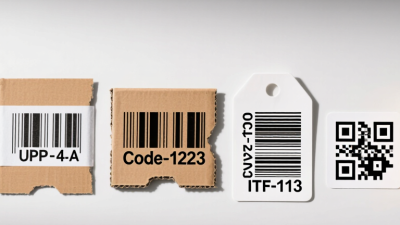
Good Ethernet Cable Labels often use strong adhesives, abrasion-resistant surfaces, and clean, easy-to-scan formats. Some support thermal-transfer printing, barcodes, QR codes, or sequential numbering. These features help technicians match physical cables with network diagrams and asset records. However, no label works perfectly in every environment. Dust, oil, humidity, repeated bending, and incorrect printer settings can still cause failure.
That is where manufacturer experience becomes visible. Leading Chinese suppliers may offer custom sizes, materials, colors, and packaging for data centers, offices, factories, and telecommunications projects. Buyers should examine samples, test adhesion, confirm printing compatibility, and review quality documentation before placing large orders. Price alone is not enough. A cheaper label may create expensive maintenance problems later. This guide evaluates manufacturers through product quality, customization capability, production consistency, technical support, and practical field reliability.
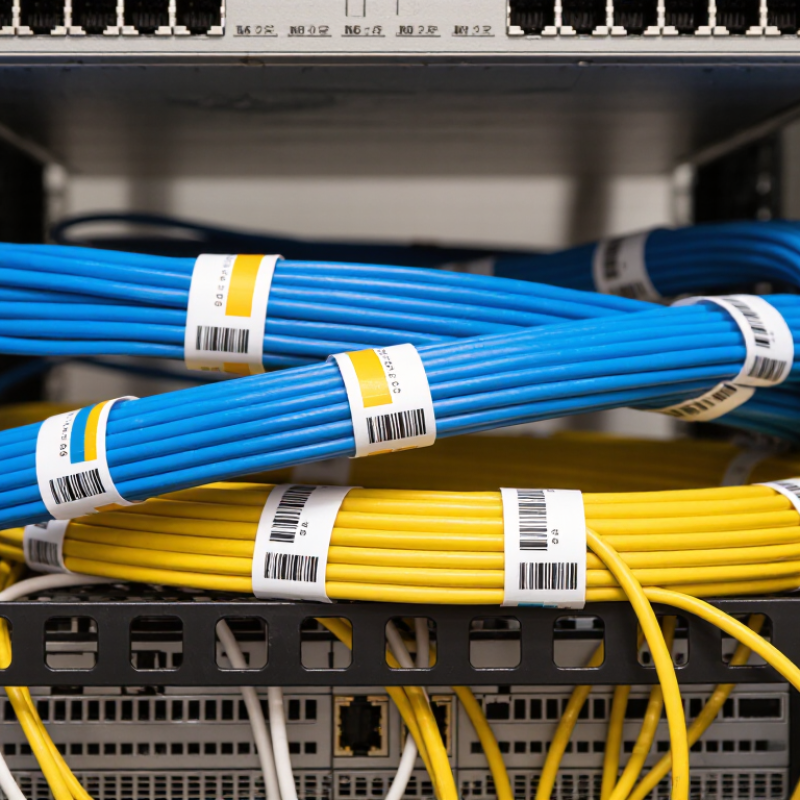
China’s Ethernet cable label manufacturing industry has grown around practical network needs. Factories produce labels for data centers, office wiring, industrial controls, and outdoor cabinets. Common materials include polyester, nylon, and heat-shrink film. Each material behaves differently under heat, moisture, abrasion, and repeated handling.
Experienced manufacturers usually begin with cable samples and installation details. They check jacket diameter, surface texture, bending radius, and expected service conditions. Printing may use thermal transfer, laser marking, or specialized digital systems. Clear contrast matters. Small barcodes must remain readable after printing, cutting, and installation. Quality teams often inspect adhesive strength, color stability, dimensional accuracy, and batch consistency. Some also test labels in humid chambers or near elevated temperatures.
Production records should link raw materials with finished batches. This supports traceability when a customer finds peeling edges or blurred characters. Reliable suppliers provide sample approval, inspection reports, and controlled packaging. Still, no factory process is perfect. A label can pass visual inspection and fail after months on a dusty cable jacket. Adhesive testing may also overlook very cold storage conditions. Manufacturers need feedback from installers, not only laboratory results. That practical loop can reveal weak corners in an otherwise efficient production system.
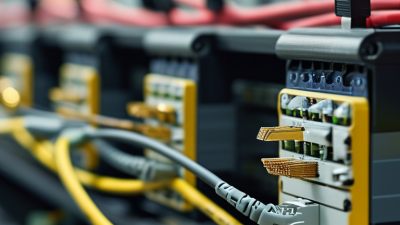
China’s Ethernet cable label manufacturers produce several formats for different installation conditions. Self-laminating labels suit copper cables in offices and data rooms. Their clear protective layer covers printed text and resists abrasion. Wraparound labels offer a simple option for short cable runs. They are quick to apply, but poor tension can cause curling.
Flag labels place identification text beside the cable, making scanning easier in dense racks. Heat-shrink labels create a tight, durable sleeve around smaller wires. They work well where movement, dust, and repeated handling are common. Port and panel labels use strong adhesives for switches, patch panels, and wall outlets. Surface preparation matters. Even good adhesive can fail on oily plastic.
Chinese factories also produce thermal-transfer, laser-printable, and blank labels for different workflows. Thermal-transfer materials support sharp serial numbers and barcode printing. Laser-printable sheets help smaller teams create labels on demand. Polyolefin, polyester, vinyl, and paper each provide different levels of flexibility and moisture resistance. In practical testing, the most attractive material is not always the best choice. A label may look clear indoors, then fade under heat or sunlight. Careful sample testing, print verification, adhesive checks, and pull tests help manufacturers improve reliability before large production. Small installation trials still reveal problems that laboratory checks can miss.
China Top Ethernet Cable Labels Manufacturers
China’s leading Ethernet cable label manufacturers compete through process discipline, not attractive printing alone. A reliable label begins with substrate selection for temperature, moisture, abrasion, and adhesive compatibility. Polyolefin sleeves suit flexible cables, while polyester markers resist cabinet friction and cleaning solvents. Small details matter.
Manufacturing usually includes digital or thermal-transfer printing, precision slitting, adhesive coating, die cutting, and batch inspection. Operators check character clarity, barcode readability, liner release, and dimensional accuracy. Samples then face rub, peel, humidity, and temperature tests. ANSI/TIA-606-C guides telecommunications labeling and administration practices. UL 969 also evaluates marking systems for permanence and legibility. ISO/IEC 11801 supports structured cabling performance requirements, although it does not replace label-specific testing.
Traceability is equally important. Each production lot should record material codes, ink settings, operator checks, and inspection results. Uptime Institute’s 2023 Global Data Center Survey reported that 60% of respondents had experienced an outage within three years. Clear identification cannot prevent every outage, but it can shorten troubleshooting time. That operational value is often underestimated.
Professional suppliers should verify print durability after installation, not only before shipment. Field conditions expose weaknesses. Adhesives may lift on dusty jackets, and small fonts can become unreadable inside crowded racks. No process is perfect. Manufacturers that document failures, revise inspection limits, and invite independent testing show stronger reliability than those relying on certificates alone.
| Manufacturing Stage | Key Quality-Control Dimension | Applicable Standard or Reference | Typical Requirement or Verified Characteristic | Common Verification Method |
|---|---|---|---|---|
| Raw Material Inspection | Conductor material and diameter | IEC 61156-5; ANSI/TIA-568.2-D | Copper conductors are commonly specified by AWG size; conductor resistance must remain within the applicable cable-category limit. | Micrometer measurement, resistance testing, and material verification |
| Insulation Extrusion | Insulation thickness, concentricity, and surface condition | IEC 61156-5; applicable national safety requirements | Insulation must provide stable dielectric performance and consistent pair geometry without pinholes, cracks, or exposed conductor. | Online diameter monitoring, spark testing, and cross-sectional inspection |
| Pair Twisting | Twist consistency and pair balance | ANSI/TIA-568.2-D; ISO/IEC 11801-1 | The four pairs use controlled, different lay lengths to reduce crosstalk and maintain balanced transmission performance. | Lay-length measurement, pair-balance testing, and process sampling |
| Cable Core Assembly | Pair separation, filler placement, and core roundness | IEC 61156-5; ANSI/TIA-568.2-D | The cable geometry should remain stable during jacketing to limit deformation, impedance variation, and pair-to-pair coupling. | Dimensional inspection, cross-section analysis, and production-line monitoring |
| Shielding, When Specified | Shield coverage and continuity | IEC 61156-5; product construction specification | Foil, braid, or combined shielding must provide continuous coverage and a reliable drain or grounding path where applicable. | Continuity testing, shield-resistance testing, and visual coverage inspection |
| Outer Jacket Extrusion | Jacket diameter, thickness, color, and surface quality | IEC 61156-5; UL 444 where a UL-rated construction is required | The jacket should be uniform, free from blisters and splits, and compatible with the intended indoor, outdoor, plenum, or riser application. | Diameter gauges, visual inspection, thickness measurement, and environmental testing |
| Cable Marking and Labeling | Legibility, traceability, and marking accuracy | ANSI/TIA-606-C for telecommunications administration; applicable safety-marking rules | Markings should identify cable category, construction, length references, rating information, and production traceability without being easily erased. | Visual inspection, rub testing, dimensional review, and batch-record verification |
| Electrical Performance Testing | Insertion loss, return loss, and impedance | ANSI/TIA-568.2-D; ISO/IEC 11801-1; IEC 61156-5 | Balanced twisted-pair Ethernet cable is generally designed around 100 Ω characteristic impedance. Frequency limits depend on category. | Calibrated cable analyzer and swept-frequency measurement |
| Crosstalk Testing | NEXT, FEXT, and power-sum performance | ANSI/TIA-568.2-D; ISO/IEC 11801-1 | Crosstalk limits vary by category and frequency; higher categories require performance over a wider frequency range. | Permanent-link or channel analyzer testing using the applicable limits |
| Category Classification | Rated bandwidth and Ethernet application suitability | ANSI/TIA-568.2-D; ISO/IEC 11801-1 | Cat 5e: up to 100 MHz; Cat 6: up to 250 MHz; Cat 6A: up to 500 MHz. Actual network speed also depends on link length and installation conditions. | Full-frequency certification test with a calibrated field or laboratory analyzer |
| Mechanical Testing | Tensile strength, elongation, bend radius, and crush resistance | IEC 61156-5; relevant installation and safety specifications | The finished cable must withstand handling and installation forces while preserving conductor continuity and transmission performance. | Tensile, elongation, bending, flexing, and compression tests |
| Flame and Environmental Compliance | Flame behavior, smoke performance, and restricted substances | UL 444 or applicable regional flame standards; RoHS Directive 2011/65/EU and amendments | The required jacket rating depends on the installation environment. RoHS compliance restricts specified hazardous substances in electrical and electronic products. | Recognized flame testing, smoke testing where required, and material declaration or laboratory analysis |
| Final Inspection and Batch Release | Sampling plan, documentation, and traceability | ISO 9001 quality-management principles; customer specification | Each released batch should be linked to raw-material records, process parameters, test results, packaging details, and corrective-action records where applicable. | Certificate-of-conformance review, lot sampling, retained samples, and audit records |
Evaluating Chinese Ethernet cable label manufacturers requires more than comparing unit prices. Start with material specifications, adhesive performance, print permanence, and production traceability.
Ask for samples using the exact cable jacket, label size, and printer process you will deploy. A label that looks sharp on day one may curl after heat, humidity, or repeated handling.
Require test records for abrasion, temperature cycling, and adhesive aging under stated conditions.
ISO’s 2023 Survey recorded about 1.27 million ISO 9001 certificates worldwide, including roughly 426,000 in China.
Certification is useful, but it is not proof of label quality. Review the certificate scope, audit date, corrective-action records, and inspection frequency.
Check whether each batch has a code linking it to raw materials, operators, and inspection results.
Also request compliance documents for applicable IEC, RoHS, and REACH requirements.
Keep the evidence.
A practical supplier audit should inspect coating storage, die-cutting accuracy, printer calibration, and rejected-label handling.
Measure ten samples from one batch. Compare dimensions, peel strength, barcode readability, and resistance after cleaning.
Ask how the factory manages adhesive changes. Small changes matter.
I would not trust a polished sample alone; production consistency is harder to prove.
Independent laboratory testing can expose weaknesses before a large installation fails.
China Top Ethernet Cable Labels Manufacturers
China’s leading Ethernet cable label manufacturers usually serve three layers of demand. Large factories focus on high-volume Cat6 and Cat6A production. Specialist plants handle shielded cables, outdoor jackets, and custom printing. Smaller engineering teams often develop labels for PoE, industrial Ethernet, and data-center identification. According to Grand View Research, the global Ethernet cable market is projected to grow at roughly 6% annually through 2030. This growth increases pressure on suppliers to prove consistency, not only low pricing.
Market applications are becoming more demanding. Data centers require clear labels that survive heat, airflow, and frequent maintenance. Smart buildings need compact labels for crowded patch panels and PoE devices. Factory networks need oil-resistant materials and strong adhesion near motors. ISO/IEC 11801 and ANSI/TIA-568.2-D remain useful references for structured cabling performance. However, a compliant cable can still have a poor label. Printing may fade. Adhesive may fail. That practical gap deserves more attention.
Tips: Ask manufacturers for label-aging tests, pull-strength results, and sample reels before ordering. Check readability after bending and heat exposure. Request batch records and color consistency data. A factory claiming “premium quality” should show measurable evidence. Market reports often describe growth, but they cannot replace physical inspection. My own view is cautious: automated testing improves reliability, yet human sampling still catches defects that machines may miss.